Royal Society Young People’s Book Prize 2026 – Shortlist Announced!
29 October, 2026The shortlist for the Royal Society Young People’s Book Prize 2026 has been announced. The award was set up over 35 years ago to celebrate high-quality, accessible STEM books and promote the joy of reading about science among under-14s.
Covering a range of topics, from an interactive introduction to the evolution of life on Earth to a spellbinding collection of science experiments to try at home, this year’s shortlist was selected by a panel of judges made up of children’s authors, science teachers and academics. The adult judging panel now hands over responsibility for choosing the overall winner to the thousands of young judges in schools, youth groups and reading clubs across the country who will be reading, discussing and debating the merits of each of the six titles before casting their votes.
Commenting on this year’s shortlist, Chair of Judges Professor Cristina Lazzeroni FRS said: ‘Chairing this panel was my favourite task of the year. Each of the books on this shortlist is a window into a different corner of science, and there is so much to learn from all of them. I hope that they will spark curiosity and become the starting point for what could be a lifelong passion for science and exploration among young readers.
‘After years of decline, the National Literacy Trust is now reporting a slight increase in both daily reading and reading enjoyment among young people. This is encouraging, and we should continue to build on this. Non-fiction books can be a fantastic way to engage those who may find reading and science a bit daunting or inaccessible. This shortlist offers a variety of approaches and perspectives, and has something for everyone.’
Congratulations to all this year’s shortlisted authors and illustrators!
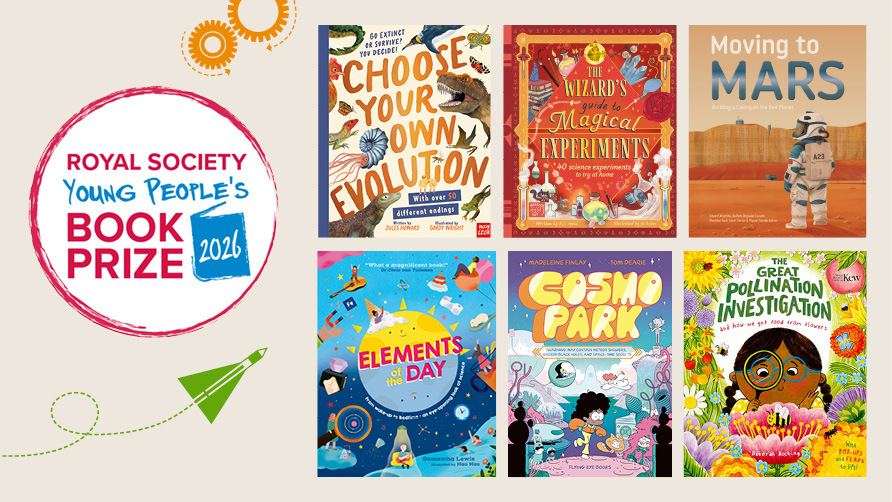
Young People’s Book Prize 2026: Shortlist
Choose Your Own Evolution by Jules Howard, illustrated by Gordy Wright (Nosy Crow Ltd)
Judge’s comment: ‘This book has really pulled off something unique and special. Its ‘choose your own adventure’ style will allow kids to journey through evolution in a highly entertaining and interactive way. Will your reign as king of the dinosaurs – the T Rex – be cut short or will you evolve to waddle among the Emperor Penguins in Antarctica?’
The Wizard’s Guide to Magical Experiments by A.J. Wood, illustrated by Jo Rioux (Magic Cat Publishing)
Judge’s comment: ‘The collection of experiments is a fantastic idea – I can really see children picking this book up. They will be engaged by the interactivity and the magical science and can then go on to explore why the experiments work the way they do.’
Moving to Mars by Eduard Altarriba, Guillem Anglada-Escudé, Sheddad Kaid-Salah Ferrón and Miquel Sureda Anfres, illustrated by Eduard Altarriba (Button Books)
Judge’s comment: ‘I really enjoyed this book. It balances a wide range of scientific questions and perspectives we would need to consider before moving to Mars, making it an approachable idea. There is a good amount of science, and the visuals are really great!’
Elements of the Day by Samantha Lewis, illustrated by Hao Hao (Red Shed)
Judge’s comment: ‘The humour, bizarreness and wonder of this book is just fantastic. It does a great job at introducing something that every child is going to study at school and that can often be quite dull.’
Cosmo Park by Madeleine Finlay, illustrated by Tom Dearie (Flying Eye Books)
Judge’s comment: ‘Through its fun illustrations and original story, this clever comic book is a great way to get real science to kids, especially reluctant readers who may prefer more visual forms of storytelling.’
The Great Pollination Investigation by Deborah Hocking (Templar Books)
Judge’s comment: ‘This is such a beautiful book! The illustrations are magnificent and there are lots of hidden interactive surprises. It introduces the science at a level perfectly suited to the younger age group of 5–7-year-olds.’
The winner of this year’s Royal Society Young People’s Book Prize will be announced at an online award ceremony in June 2027. Find out more about the award and how your school could get involved here.