The Teacher’s Bookshelf: CPD titles to support your literacy teaching
16 June, 2026 Welcome to The Teacher’s Bookshelf, our blog series highlighting must-read titles to support your literacy teaching and professional development. Each half term, we ask a literacy expert to share four or five books that have made a real difference in their work – titles that offer fresh thinking, proven strategies, and real classroom impact. Whether you’re exploring a new topic or refining your approach, these hand-picked recommendations are sure to be a valuable addition to your staffroom or home library.
We are delighted to welcome Karen Warwick as this term’s guest reviewer. Karen has worked in primary education for over 30 years – as a class teacher, an EAL specialist teacher within local authority EAL teams and, more recently, as an EAL trainer for The Bell Foundation. Throughout her career, Karen has been passionate about supporting schools to develop inclusive practice and a deeper understanding of EAL pedagogy so that multilingual learners are provided with the opportunities, support and sense of belonging they deserve.
How multilingual families shaped my EAL journey
One of the greatest privileges of my work has been building relationships with multilingual families – listening to their stories, learning about their journeys, celebrating their cultures and languages, and supporting them as they navigate the UK education system. These experiences have continually shaped and enriched both my teaching and my understanding of education.
When I began my professional EAL journey, there was a limited amount of literature about teaching and supporting EAL learners available. However, what was around was pioneering in its inclusive messaging. The following titles have all been valuable additions to my professional bookshelf, and they are books I return to frequently. I hope you find them useful too.
A Golden Oldie
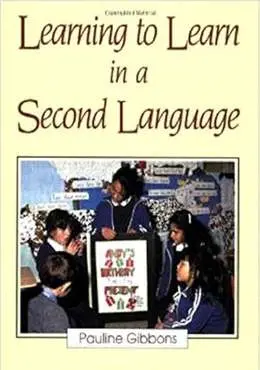
Learning to Learn in a Second Language by Pauline Gibbons (Heinemann, 1993)
I was first introduced to this book in 1997, when I moved from being a class teacher to join a local authority EAL team. It was a recommended read for the interview process at the time. I recall thinking, Why haven’t I seen this book before? Why wasn’t this included as part of my PGCE? Though published over 30 years ago, the key messages and suggestions in this book remain as relevant today as they were then. Multilingual learners have a double job to do – to learn a new language and to learn in that language.
Pauline Gibbons, a pioneer and expert in the field of EAL, explains how multilingual learners acquire a new language and how they develop their speaking, reading and writing skills. Woven throughout, is the message that interactions with others are a key tool for developing spoken language and, in turn, language proficiency. The reader is also introduced to the importance of planning for the language needed to access and understand the curriculum content, ensuring that language development is integrated and situated in a meaningful context.
All the strategies discussed are practical, classroom-based and grounded in EAL pedagogy and research. They are founded on the principle that learning through the curriculum in the mainstream classroom is the best way for multilingual learners to develop their language, and that a whole-school approach is vital.
After 30 years, I return to Pauline Gibbons’ work time and again for solid advice and to affirm good practice. I encourage any teacher who is new to working with multilingual learners, or any teacher who just needs a reminder, to dip into this very accessible book and discover that what is good for EAL learners is good for all learners.
Something for secondary practitioners
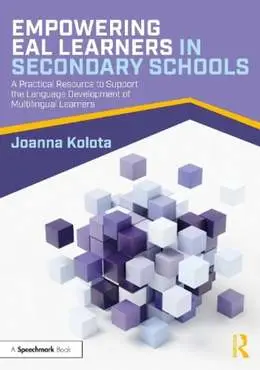
Empowering EAL Learners in Secondary Schools: A practical resource to support the language development of multilingual learners by Joanna Kolota (Routledge, 2024)
Secondary school can be challenging enough; for multilingual learners, the social and academic demands can be even greater – particularly if you arrive in Year 7 following a potentially disruptive educational journey. This scenario sets the scene for the chapters to come in this recently published book by Joanna Kolota, an experienced secondary practitioner and the Curriculum Lead for Multilingual Learners at Trinity Academy, Leeds.
This is a comprehensive and practical book for all secondary school educators who are planning for and supporting multilingual learners across the curriculum. Starting with an exploration of what English as an additional language means and who EAL learners are, the author goes on to explore the specifics of vocabulary development, using vocabulary in sentences, and reading and writing for multilingual learners.
Joanna Kolota firmly reminds us that all teachers are teachers of language, and that planning for language should be considered an integral part of lesson preparation, not seen as an ‘add-on’. She echoes a key message from Pauline Gibbons; that multilingual learners have a double job to do – to learn English and to learn through English – and emphasises the importance of appropriate ‘content-driven’ and ‘ambitious’ access to the mainstream curriculum, regardless of the level of proficiency in English. Chapter 5 provides a concise and helpful explanation of the distinction between ‘simplification’ (simplifying content, by removing complicated language or restructuring a text) and ‘easification’ (reducing potential language barriers by modifying content using EAL-friendly strategies), and the importance of ‘striking the balance’ to ensure that content is accessible and comprehensible for multilingual learners.
Packed with visual examples of tried-and-tested adaptive strategies throughout, this book is an invaluable addition to the staffroom CPD shelf in any secondary school.
Theory and practice for today’s multilingual classrooms
The researchED Guide to English as an Additional Language: An evidence-informed guide for teachers, edited by Hamish Chalmers, Series Editor Tom Bennett (John Catt Educational, 2022)
How can classroom tasks be adapted to help support and develop proficiency in English? Why should EAL assessment be curriculum-based? How can practitioners embed EAL assessment in practice? These are some of the questions teachers in multilingual classrooms frequently ask, and which this user-friendly, evidence-informed book addresses.
Divided into three main sections, the guide offers short, accessible chapters covering a range of topics that address considerations for both ‘the bigger picture’ and the nitty-gritty of supporting EAL learners in the mainstream classroom. What is refreshing about this book is its collaborative approach, with insights from both teachers and researchers in the field, and links to useful resources and further research at the end of each chapter.
Since the book’s publication, the questions explored have become even more pertinent, not only because of the rising diversity evident in today’s classrooms but also in light of the recently revised OFSTED Inspection Toolkit (2025), which now includes specific statements on expectations for EAL education and provision. With this in mind, if you have responsibility for EAL provision in your setting and are looking for answers and current thinking to empower and support you – or to influence senior leaders and management teams to strengthen capacity for EAL provision – this book is a ‘must-read’ recommendation for any teacher’s bookshelf.
For those involved in Initial Teacher Training – and beyond
The EAL Teaching Book: Promoting success for multilingual learners (4th edition) by Jean Conteh (Sage, 2023)
This is an excellent book and does exactly what it says on the tin: it teaches about EAL teaching. Jean Conteh, now retired, was the senior lecturer in the School of Education at Leeds University. While she wrote the book to inform and support trainee teachers, it offers something for everyone. Along with Pauline Gibbons’ Learning to Learn in a Second Language, this is a book I return to time and time again.
This book talks to teachers (training or not) and reiterates many of the key messages mentioned in the other recommendations in this blog. It highlights the need for ‘EAL’ knowledge to be part of all teachers’ professional knowledge, and discusses and challenges misconceptions about teaching multilingual learners, language acquisition, and learning in general.
The book is divided into two parts. Part 1 sets the context for Part 2, which focuses on practical approaches for teaching multilingual learners. Each chapter includes a set of learning outcomes at the beginning and concludes with a brief summary of the key points covered. Each chapter also includes case studies – provided by teachers – and thought-provoking activities and questions to develop teachers’ EAL knowledge. A brief summary of each chapter in the Introduction is a useful feature that makes navigating the book quick and easy.
The EAL Teaching Book is now in its fourth edition, with updates and new material added each time to keep the subject matter fresh and current. My copy is the third edition, which includes an excellent chapter on EAL and Early Years. For the latest edition, a new and timely chapter on EAL and SEND has been added. I cannot recommend this book highly enough and look forward to the next edition.