Writing Enjoyment and Engagement in 2025
25 June, 2025 The National Literacy Trust has published its latest report on writing enjoyment and engagement among children and young people. The 43-page report is based on the responses of nearly 115,000 children and young people aged 5-18 from 515 schools across the country. As you would expect, it contains a huge amount of data covering insights into writing enjoyment, writing habits and writing motivation. In this blog we have picked out our top 13 takeaways, but you can read the full report for yourself here.
Writing Enjoyment
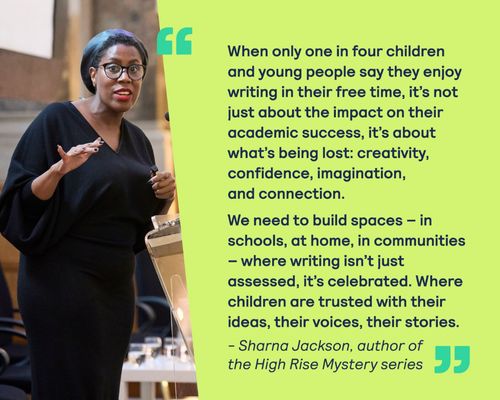
1. The number of children and young people aged 8-18 who say that they enjoy writing in their free time has dropped to a 15-year low. Only 1 in 4 (26.6%) young people said they they enjoy writing in their free time in 2025. In 2010, when the first survey results were published, the figure was closer to 1 in 2 (46.8%).
2. This year, the decline has been most marked among primary-aged children, with only 40.9% of 8-11 year-olds saying that they enjoy writing in their free time in 2025, compared to 47.4% in 2024.
3. The decline in writing enjoyment and engagement appears to mirror a decline in writing attainment. In recent years, writing has emerged as the lowest-performing area in national assessments. In 2024, 28% of 11-year-olds in England left primary school without having met the expected standard of writing, rising to 42% among pupils from disadvantaged backgrounds.
4. While the 8-11 age group has seen the steepest decline this year, primary-aged children are still more likely to enjoy writing in their free time than young people of secondary school age.
5. Even amongst the youngest children (aged 5-8), writing enjoyment in 2025 has fallen to its lowest level since data was first collected in 2019, down by 14.3 percentage points (60.4% vs 74.7%).
6. Girls have consistently reported higher levels of writing enjoyment than boys. While the gender gap has narrowed, this is because levels of writing enjoyment have fallen more steeply for girls in absolute terms.
 Writing Habits
7. After a dramatic fall in 2024, the number of children who choose to write every day has remained relatively stable in 2025. However, numbers are still at historically low levels, with only 1 in 10 (10.4%) children and young people aged 8-18 reporting that they write something daily in their free time, compared with 1 in 4 (27.0%) in 2010.
8. In the 15 years since records began, children eligible for FSM have consistently been more likely to enjoy writing in their free time than their peers who do not receive FSM and that trend continues in 2025 (31.1% vs 25%). The same is true of writing habits, with 13.6% of FSM students writing daily compared with 9.6% of their non-FSM peers.
Writing Motivation
9. The survey identifies four writing profiles based on the responses from children and young people who choose to write in their free time at least once a month – the Creative Writer, the Curious Writer, the Mindful Writer and the Social Writer. These profiles reflect the range of creative, emotional, intellectual and social drivers for the act of writing. Of the four profiles, the Creative Writer and the Curious Writer are the most common, with the top five reasons for writing being:
- to feel creative (48.7%) – Creative Writer
- to note down things I don’t want to forget (47.3%) – Curious Writer
- to express my ideas and imagination (45.8%) – Creative Writer
- to improve my writing skills (44.4%) – Curious Writer
- to express my thoughts and feelings (40.8%) – Creative Writer
10. The number of young people aged 11-18 choosing reasons to write from the Mindful Writer profile have risen over the last two years. Mindful Writers use writing as a tool to explore their emotions, process their experiences and help promote a sense of wellbeing. In 2023, only 28.4% of 11-14 year-olds were identified as Mindful Writers, compared with 40.8% in 2025. Similar increases can be seen in the 14-16 and 16-18 age-groups.
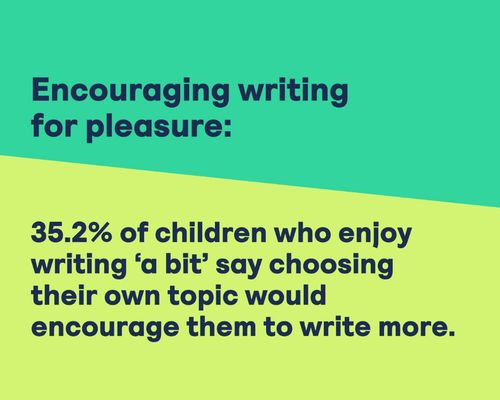 11. In order to understand what factors might encourage young people to engage more with writing, pupils were given a list of 11 options and could choose as many as they wanted. For young people aged 8-18 who enjoy writing ‘very much’, ‘quite a lot’ or ‘a bit’, the top motivating factor is the freedom to ‘choose what I want to write about’. Even for those young people who do not enjoy writing ‘at all’, this is still the second most important driver.
12. Choice, autonomy and sharing their own personal experiences are key motivating factors for all young writers. However, young people who only enjoy writing ‘a bit’ or ‘not at all’, would seem to benefit from a bit more scaffolding in the form of greater guidance in terms of topic choice or interesting prompts to help get them started.
13. Even among children and young people who say they don’t like writing, many still choose to write in their free time across a range of formats, both on screen and on paper. Diary entries, letters, free writing, song lyrics and short stories/fiction are the top formats, with song lyrics being written mainly on screen while around 1 in 5 choose to write diary entries and letters on paper.
Commenting on this year’s report, Jonathan Douglas, CEO of the NLT, said: “The findings offer a sobering view of writing culture in the UK but also point to actionable insights. By focusing on what motivates children and young people, particularly autonomy, creativity, and personal and cultural relevance, they are far more likely to engage with it on their own terms. That’s where true progress begins.”