Children and Young People’s Reading in 2026
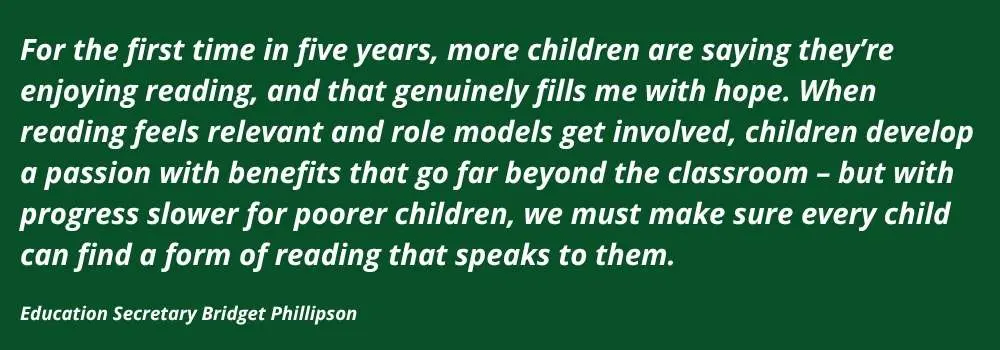
10 June, 2026For the first time since 2021, the results from the National Literacy Trust’s report on Children and Young People’s Reading in 2026 show ‘a small but important’ increase in both reading enjoyment and daily reading among children and young people aged 8–18. After last year’s 20-year low, that is welcome news.
 Green shoots of recovery
The Children and Young People’s Reading report has been tracking the reading behaviours, attitudes and experiences of children and young people since 2005. The report focuses on the reading done in young people’s free time and includes all kinds of reading, in print or on a screen.
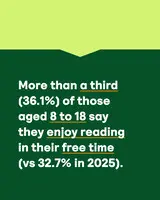
This year’s survey gathered the views of over 125,000 children and young people aged 5–18 from 479 schools across the UK between January and March 2026. The results show that more than a third (36.1%) of those aged 8–18 now say they enjoy reading (up from 32.7% in 2025), while a fifth (20.3%) read daily in their free time (up from 18.7% in 2025).
Levels of enjoyment and daily reading increased across all four age groups, but the increases were most marked among young people aged 14–16 and 16–18.
Still more work to be done
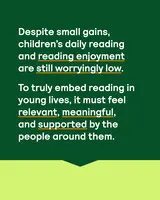
While this year’s results are encouraging, levels of reading enjoyment and daily reading remain worryingly low and lag well behind those seen in the mid-2010s, when over half (58.6%) of children and young people aged 8–18 said they enjoyed reading in their free time (2016) and 43.0% reported reading daily (2015).
Figures for the 5–8 age group are also a cause for concern. While this age group reports higher levels of reading enjoyment than those seen among older children and young people, this year’s figures show a year-on-year decline for the third consecutive year, falling from 62.6% in 2025 to 61.6% in 2026.
Overall daily reading figures for this age group rose slightly from 44.5% in 2025 to 45.5% in 2026, but this was mainly driven by an increase in daily reading among girls (50.5%). Across both reading enjoyment and daily reading, the gender gap in this age group widened in 2026, rising from 7.6 percentage points (2025) to 10.8 percentage points (2026) for reading enjoyment and from 7.3 percentage points (2025) to 9.4 percentage points (2026) for levels of daily reading.
A growing gap of disadvantage
The research also highlights widening inequalities by free school meals uptake (FSM) for children and young people aged 8–18. While reading enjoyment and daily reading for both FSM and non-FSM groups increased in 2026, the increases were greater among children who did not receive FSM.
According to the findings, the disadvantage gap in reading enjoyment more than doubled in the past year from around 2 percentage points to over 5 percentage points. The daily reading gap also widened from 3.6 percentage points to 5.1 percentage points.
Differences by socioeconomic background were also more apparent for reading support at home, with fewer children and young people in receipt of FSM reporting that they are encouraged to read at home than their non-FSM peers. Levels of encouragement from teachers at school were broadly similar for both groups.
On a more positive note, children and young people in receipt of FSM were more likely to report that reading helps them explore their interests than their non-FSM peers, regardless of levels of reading enjoyment and frequency.
Why children and young people read
Perhaps unsurprisingly, the report found that when children and young people (8–18) enjoy reading, they read more often: ten times as many children and young people who enjoy reading said they read regularly in their free time, compared to those who said they did not enjoy reading (49.8% vs 4.5%).
However, the report also found that ‘while enjoyment is closely linked to how often children and young people read, it does not fully explain reading behaviour. Many continue to read without enjoying it, while others who enjoy reading do not read frequently.’ Around 1 in 3 (34.6%) children and young people who do not enjoy reading read at least once a week, and more than 3 in 5 (62.3%) read at least once a month in their free time.
Children who enjoy reading and read regularly were most likely to say that reading helps them learn new things, perform better at school, understand other people, understand themselves, relax and manage feelings of stress or anxiety. However, these wider benefits were also recognised by children and young people who do not enjoy reading. Across all levels of reading engagement, the most widely acknowledged benefits of reading included:
- learning new words or new things (69.8%)
- helping them to explore their interests (48.7%)
- performing better at school (48.1%)
- understanding the views of others (45.3%)
Support from engaged adults, in school and at home, remains a significant factor: two thirds (65.8%) of children and young people said they are encouraged to read by their teachers and more than half (54.8%) by their parents.
The report concludes: ‘As the National Year of Reading begins, this report offers both encouragement and a clear reminder that progress cannot be taken for granted. The small rise in reading enjoyment and daily reading is welcome, particularly after several years of decline. But the uneven pattern of change shows that continued attention is needed to ensure that more children and young people can find reading enjoyable, relevant and worthwhile.’
The full Children and Young People’s Reading in 2026 report can be read here.